News Story
Media contact
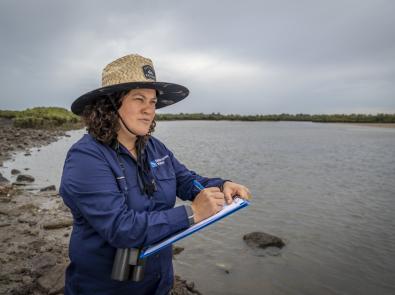
Heremaia Titoko knows the challenges women face in science. Now a key member of Melbourne Water’s Waterways and Services South East team, her journey to her “dream job” wasn’t easy. On the International Day of Women and Girls in Science, Heremaia reflects on achieving her dream despite feeling “pushed out of scientific spaces”.
Her journey highlights a national challenge: women make up just 15 per cent of Australia’s STEM workforce despite efforts to improve representation.
It also reflects Melbourne Water’s commitment to diversity, with nearly half its science and research roles filled by women.
Heremaia’s story is about personal ability, cultural connections, science - and lots of determination.
As a child, she explored nature and worked with her Dad in his shed, curious about how things worked.
“We’d tinker with welding projects, pulley systems, and electrical circuits,” she recalls. “That’s where my love of science began, blending creativity and problem‑solving.”
She wasn’t always encouraged at school and confronted gender bias when a teacher said she “wasn’t smart enough” to do VCE chemistry. Back then, some subjects were said to be “too hard” or “not for girls”.
Instead of being discouraged, she became determined “to prove... that curiosity and capability aren’t defined by gender or by someone else’s expectations.”
Her physics teacher became a mentor, showing her that science was for anyone curious enough to explore it.
After school, Heremaia enrolled in Applied Physics at RMIT but, feeling isolated as one of few women, decided to withdraw.
She worked at Australia Post for nearly 20 years and had three children.
“But the pull back to science never went away,” she says. While raising her family, she enrolled in Environmental Science at Charles Sturt University, specialising in land and water.
“It was challenging, but reminded me why I loved science. The more I learned, the more I wanted to help tackle environmental challenges in a warming climate.
“That decision ultimately brought me full circle, back into the scientific world with a blend of life experience, resilience, and a renewed sense of purpose.”
Aptitude, interests, and cultural connections drove her to science.
“I have Māori heritage, and to me water is the foundation of life, something we must protect to sustain communities and all species.”
Travels to arid Australia deepened her connection, seeing links between groundwater flow and Songlines reflecting ancient environmental understanding.
After graduating, she worked for Parks Victoria and the North Central Catchment Management Authority in ecological water roles.
In 2024, she joined Melbourne Water as a Waterways and Land Officer, discovering opportunities to improve rivers, wetlands, and catchments.
She is now the Western Port Ramsar Partnerships Coordinator and supports the Bayside and Dandenong team.
“The Ramsar role is my dream job. It brings together everything from my studies, career, and cultural background,” Heremaia says.
“Western Port is one of Victoria’s most important wetland systems, and coordinating partnerships across agencies, community groups, researchers, and Traditional Owners is essential to protecting it in a changing climate.
“I’m grateful to have this opportunity and support from Melbourne Water in a role that aligns with my values and experience.
“This role connects to my journey as a woman in science. I didn’t follow a traditional pathway and sometimes felt pushed out of scientific spaces.
“Now, working to protect a Ramsar‑listed wetland, I’m reminded science needs diverse voices and perspectives.
“I’m proud to bring my Māori heritage, skills, and scientific training together to support ecological outcomes, and to show what women in science can achieve when supported and valued.”