 Media release
Despite rain falling throughout November, Greater Melbourne Water’s storages have risen marginally since the end of winter as Victoria heads into what’s predicted to be a hotter-than-average summer.
Average spring 2025 rainfall over Melbourne Water’s four major harvesting catchments – Maroondah, O’Shannassy, Thomson and Upper Yarra – was 316.5 mm, or 4.4 per cent above the 30-year average.
Despite this, spring stream flow into the catchments was 135.9 billion litres, 24.2 per cent below the 30-year average, reflecting drier than average conditions earlier in spring.
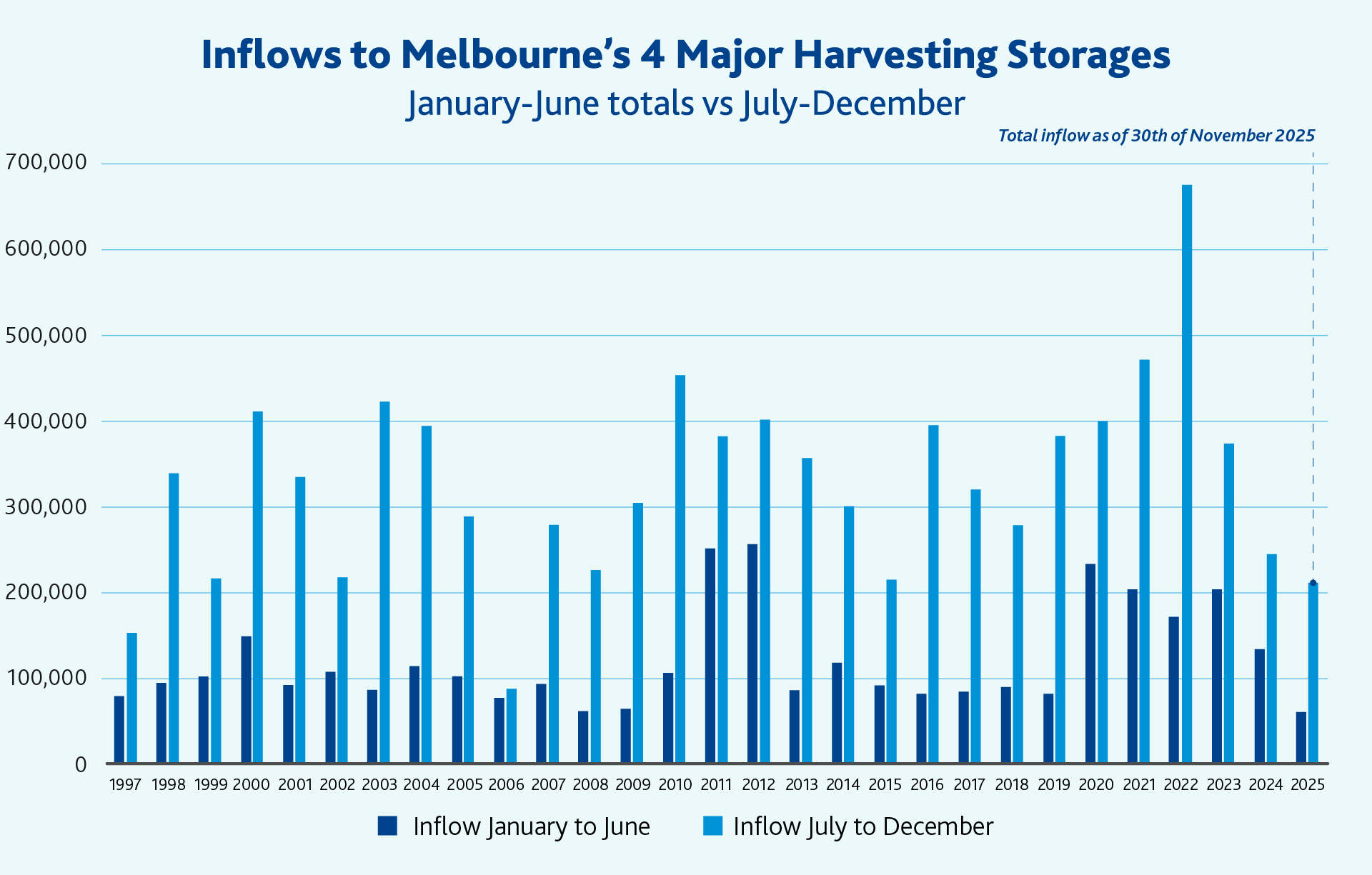
The November rain had limited impact on overall storage levels, which were at 72.4 per cent capacity at the start of spring and currently sit at 75.5 per cent.
As we enter summer, storages are 13.2 per cent lower than they were at the end of spring 2024.
The release of the latest data comes as the Bureau of Meteorology predicts above average and even extreme temperatures over summer, while there is no clear signal on whether we’ll have above or below average summer rainfall.
Water storages have been supplemented by just over 31 billion litres of desalinated water over spring, bringing the total so far this year to 50 billion litres. This buffer has helped stabilise supply and reduce the risk of water restrictions.
“With Victoria about to face a long hot summer with unpredictable rainfall, it’s vital that all Melbournians continue to use water wisely, given that water use increases over summer,” said Melbourne Water Executive General Manager, Service Futures, Chris Brace.
Water use in Melbourne was slightly down, with 1,253 million litres per day consumed during spring, a 2.9 per cent drop compared to the same period last year, equating to 37 million litres less per day than in 2024.
“While the November rain has helped, and desalination has given us a buffer, it has been a dry year overall and Permanent Water Saving Rules remain in place year-round to encourage conservation efforts,” Brace said.
“Simple actions like shorter showers, turning off taps while brushing teeth, using a broom instead of a hose for outdoor cleaning, can save precious water – because every drop counts.
“As our city grows, sustainable water use will help protect Melbourne’s liveability, ensuring it remains an exceptional place to live, now and for generations to come.”
The Target 150 initiative encourages individuals to limit daily water consumption to 150 litres per person. More information on managing household water use can be found in quarterly bills and online via Melbourne Water’s water conservation resources.